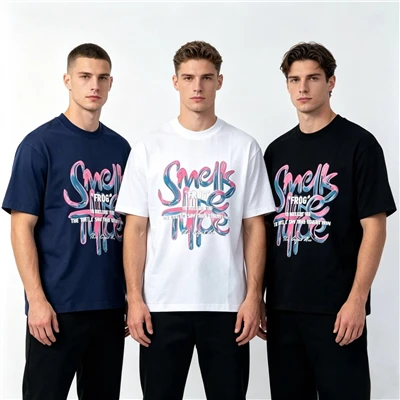
When selecting men's pure cotton T-shirts-especially those intended for summer wear-it is advisable to choose styles with a fabric weight of at least 180 grams per square meter (gsm). For those who prioritize comfort and breathability, a weight range of 220 gsm to 280 gsm is recommended, typically paired with a yarn count between 24 and 32. Fabric weight refers to the mass per square meter; a higher weight indicates a thicker, heavier fabric. Conversely, a higher yarn count generally corresponds to a lower fabric weight, resulting in a thinner, softer material. Standard T-shirts typically fall within the 180–200 gsm range, while "heavyweight" T-shirts-those exceeding 220 gsm-offer greater durability and a better drape, though they may sometimes feel less breathable or even stuffy. On the other hand, fabrics that are too light may lack comfort. Consequently, the 220–280 gsm range is considered an ideal balance between durability and breathability.
The yarn count is another key factor influencing both softness and durability. A higher yarn count indicates finer threads, which yield a softer, smoother fabric; however, this also entails a more complex production process and, typically, a higher price point. For everyday wear, a yarn count of 24 or 32 is generally sufficient. While a very high yarn count may result in a more refined appearance, such fabrics are more prone to breaking or tearing after repeated washing-making it wiser to opt for a more appropriate, moderate yarn count.